Skip to content



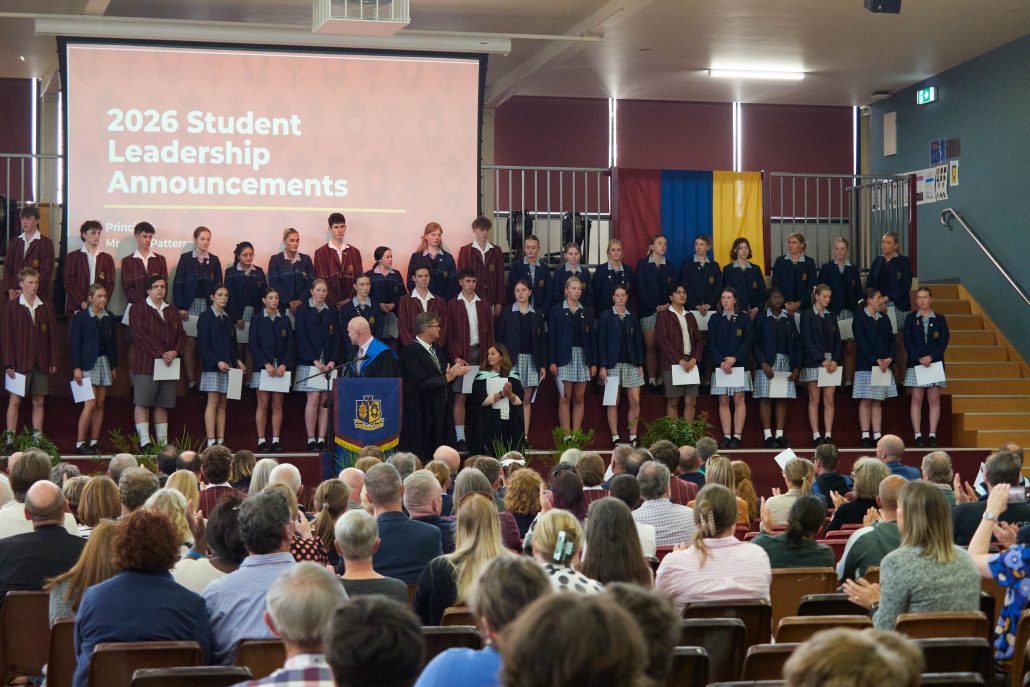
As our 2026 Student Leadership group were offically inducted into their roles, Head of Senior School, Stuart Walls, spoke to them about leadership:
Each of you today is entrusted with something significant—something greater than a badge, a title, or a position. You are being entrusted with people. With your peers. With your community.
Across this College, the philosophy of leadership is based on the simple idea: that a true leader is a servant first. This is not a slogan; it is a way of being. It demands courage, humility and a willingness to put others ahead of yourself. It asks not, “How can I be important?” but “How can I make a difference?”
Today, I want to reflect on someone whose life shaped the world and whose example strengthens the idea of servant leadership more powerfully than almost any other—Nelson Mandela. I grew up in South Africa, and I lived through the years when the country transformed from a nation deeply divided by injustice and racial segregation to one that chose peace over revenge, reconciliation over retaliation, and unity over destruction.
I was at university in Johannesburg in the late 1980s and I remember the tension and the fear in my society at that time. I remember a country that many believed was on the brink of civil war. And I remember 1990—the year Nelson Mandela walked out of prison after 27 years. Many expected anger. Many expected violence. Many expected revenge. Instead, what the world witnessed was the opposite. Mandela walked out of prison with a smile, greeting his jailers by name, and speaking not of punishment, but of hope.
He said: “Resentment is like drinking poison and then hoping it will kill your enemies.” He taught a nation that hatred only destroys the one who holds it. He chose forgiveness—not because it was easy, but because it was necessary.
In 1994, when Madiba, the clan name that Nelson Mandela was fondly known by, became the first democratically elected President of South Africa, he stood facing a future that could easily have collapsed. And he said: “I stand here before you not as a prophet, but as a humble servant of you, the people.” A humble servant. That was how he defined leadership. Mandela’s leadership was never about power. It was never about authority. It was always about people. His goal was never to be admired, but to unite. He understood something essential: “It is better to lead from behind and to put others in front.” He would invite people who once fought against him to sit at the table. He would listen to those who disagreed with him. He sought to understand before trying to be understood. And that spirit changed the culture of an entire country.
Mandela showed that servant leadership has the power not only to guide people, but to heal them. I share this today not as a history lesson, but as a reminder that the leadership roles we are recognising today represent something much more profound than personal achievement. They represent service to a community. One of the most important things to know about student leadership is that it is not awarded by chance—it is earned through trust. I have always found it fascinating that when young people choose their leaders, they do not choose the loudest voices, the biggest personalities or the people who push themselves to the front. They choose humility. They choose kindness. They choose those who listen. They choose those who make others feel valued and included.
Your peers have chosen you because of who you already are—not because of what you achieve on a stage or in a spotlight, but because of what you do quietly every day. Servant leadership is not dramatic. It is often invisible. It is found in small actions: checking on someone who is having a bad day, giving your time to help others succeed, stepping back so someone else can step forward, refusing to leave anyone behind.
Another remarkable servant leader, Mother Teresa, once said: “Do small things with great love.” Leadership begins with exactly that. So, as you step into your roles, I want to offer three thoughts from Nelson Mandela’s example that I hope will guide you:
Number 1. Courage begins with humility. Mandela said: “The brave man is not he who does not feel afraid, but he who conquers that fear.” Leadership will demand courage—the courage to stand up for what is right, the courage to include the excluded, the courage to correct injustice even when it is uncomfortable. But courage is built on humility: the understanding that leadership is not about being right, but about doing right.
Number 2. Listen to serve, not to reply. Mandela was a leader who always listened before he spoke. He believed deeply that everyone deserves to be heard. When people feel heard, they feel valued. And when they feel valued, they follow not because they are told to, but because they want to. As leaders here at Scotch Oakburn, your most powerful tool will be your ability to really listen to the voices around you.
And thirdly – Put the needs of others before your own. Real leaders lift others. They walk beside them. They use their strength to strengthen those around them. Mandela also said: “A good leader can engage in debate honestly and thoroughly, knowing that in the end, both sides emerge stronger.” Leadership is not about winning—it is about building.
In the coming year, challenges will arise. Mistakes will happen. Doubts will creep in. You will sometimes feel the weight of expectation. But remember this: You were not chosen to be perfect. You were chosen because you care. A great American servant leader, Martin Luther King Jr., once said: “Life’s most persistent and urgent question is: What are you doing for others?” If you can answer that question every day, even in small ways, you will have succeeded.
To our 2026 leaders: you will shape the tone of this College. You will influence how your peers treat one another. You will determine whether every student feels they belong, whether they feel known, valued and cared for. Your title lasts one year. Your impact can last a lot longer. As you are inducted today, you are not stepping into privilege—you are stepping into responsibility.
So I challenge you to lead as Mandela led: With humility. With courage. With kindness. With service at the centre of everything you do. I stand here as someone who watched a nation held together by the power of servant leadership. I saw a man who had every reason to hate, choose love instead. I saw the impossible become possible because one leader refused to lead from above, but chose to lead from among his people. May you be that kind of leader.
And when your year concludes, I hope your peers say: “They made us feel safe. They made us feel proud. They made us better.” Congratulations to each one of you. Serve well. Lead well. And remember: one last time in the words of Nelson Mandela: “What counts in life is not the mere fact that we have lived. It is what difference we have made to the lives of others.”