Skip to content



ROUND SQUARE PEACE GATHERING
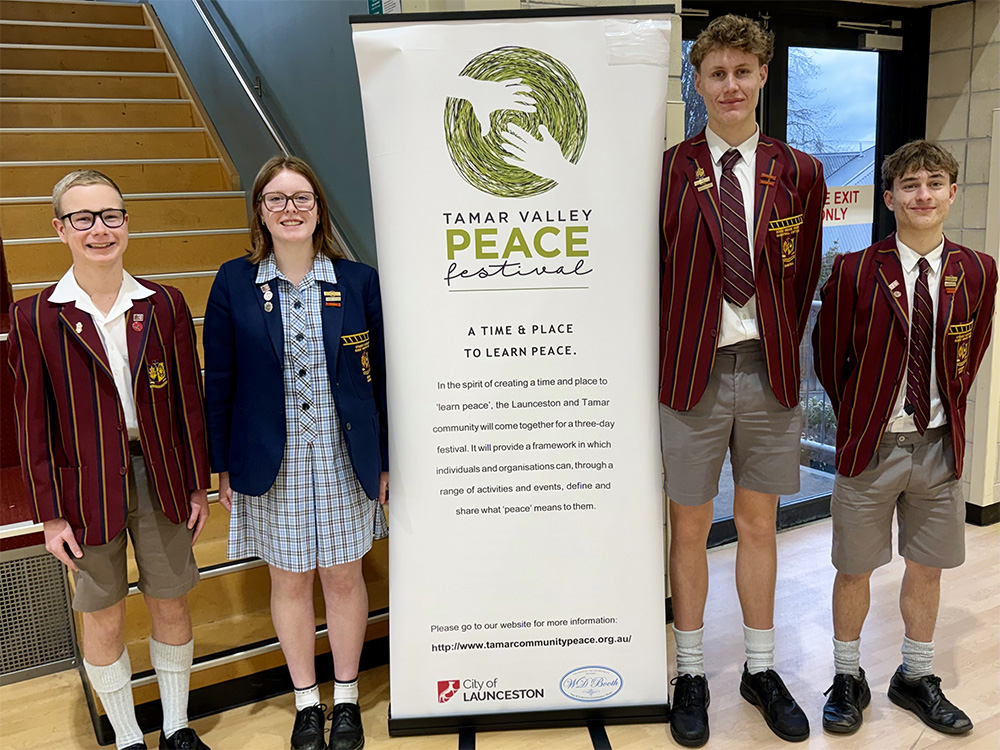
This year’s Round Square Peace Gathering once again drew on the College’s affiliation with the Tamar Valley Peace Festival — a connection stretching back over a decade.
The Tamar Valley Peace Trust was founded in 2015 by a group of Launceston residents to encourage a more peaceful approach to resolving conflict, grounded in community, global, environmental and social perspectives. The idea began with peace activist Mrs Jean Hearn, who was inspired by former Tasmanian Governor Peter Underwood’s 2008 ANZAC Day address. In that speech, Governor Underwood challenged all Tasmanians to “actively strive for peace on a daily basis and learn ways of resolving conflict without violence” — words that are particularly relevant in 2026.
It’s this spirit that shapes each year’s Peace Gathering address. This year, the College welcomed Year 10 student Grayson Edwards as the 2026 speaker, who delivered this speech:
“Peace Starts with Us” — Grayson Edwards
When we hear the word peace, our minds often go straight to the opposite. We picture a surrender on the battlefield, a truce between sides, the disarming of weapons, the stop of a direct conflict. And that is certainly peace. But peace can be something much broader.
Because peace exists at every level of our lives.
Within a nation, peace can mean people choosing to support and co-exist with one another despite differing beliefs.
In our communities, peace can mean deciding disagreements fairly, even if that means your side will not win.
Between individuals, peace can mean offering support instead of critique, acceptance over judgement.
One of the clearest examples of choosing peace can be found in South Africa’s transition away from Apartheid. Apartheid is a system of institutionalised racial segregation, implemented in South Africa from 1948 to 1994. After decades of minority rule by the National Party, international and domestic attitudes were shifting, no longer content with this status quo of inequality. For years, protests and uprisings occurred all around the country, and the future looked uncertain. There was enormous potential for retaliation.
Yet, peace was chosen.
Despite experiencing the repression firsthand — having been imprisoned for 28 years — Nelson Mandela chose peace: “If you want to make peace with your enemy, you have to work with your enemy. Then he becomes your partner.” Over the next four years following his release, Mandela negotiated with leaders of the National Party, leading to the first free election in South African history in April 1994, where Mandela’s party, the African National Congress, won 63% of the vote.
South Africa’s problems did not disappear overnight, but it set the solutions in motion. The choice to pursue reconciliation demonstrated something important: peace does not mean pretending conflict never occurred. It means working together to decide what happens next.
Most of us will never be in a position to negotiate between opposing sides at a global level. But we constantly face smaller versions of the same choice.
Martin Luther King Jr. once said: “Peace is not merely a distant goal that we seek, but a means by which we arrive at that goal.”
This means peace cannot be something we simply hope for in the future — instead, it must be something we actively strive for today, by practising peace now, on our way there.
Peace starts with how we speak to the person we disagree with.
Peace starts with listening before assuming.
Peace starts with refusing to turn differences into divisions.
Peace starts with including someone who might otherwise be left out.
And sometimes, peace starts with something as difficult as… admitting that we were wrong.
These actions might seem insignificant when compared with global conflicts. But individuals make up communities, communities make up states, states make up countries, and countries make up the world.
When we focus on our world, it can be easy to see just the conflicts: the war in Ukraine, the Israeli-Palestine conflict, the civil war in Sudan, and so many others.
Examples of conflict over peace. These problems are no doubt of monumental scale, but we must remember the hope of resolution starts at an individual scale. It starts with us accepting one another, helping one another, and refusing to let power divide us.
If peace is something we only expect from world leaders, then we have misunderstood it. Peace should be something that starts with us.
So — when you think of peace, don’t picture the end of a war. Picture people helping one another to achieve a goal. Instead of imagining a handshake between leaders, imagine a world where differences no longer divide us.
Peace doesn’t just begin when the world’s greatest conflicts are solved, and peace shouldn’t be something we have to imagine. Peace should be something we are constantly working towards, together.
It begins in our schools, our communities, our families, and in the choices we make every day.
Individually, we cannot create world peace. But together, we can choose what kind of community we create, what kind of country we live in, and what kind of world this is.
Peace starts with us.
Grayson Edwards
Year 10